Why practice out loud
Most people prepare by reading questions and thinking about answers. The problem shows up when you have to say them: you ramble, you forget your best example, you fill gaps with “um”. Speaking is a separate skill and it improves with repetition.
How to run a useful mock interview
- Pick the right stage. A first screening call, a behavioral interview and a final round with a hiring manager ask different questions.
- Use the real job ad. Questions should come from the duties and requirements you will be asked about.
- Answer out loud, in full. Do not skip the questions you find hard.
- Record or review the answers. Check length, structure, and whether you gave a concrete example and result.
- Redo the weak ones. Repeat the answer until it is clear and short.
With a friend, a coach, or an app
- A friend is free and gives social pressure, but may not know what a good answer is.
- A coach gives expert feedback but costs more and needs scheduling.
- An app is available at any time and repeatable, but it is practice, not a promise about the real result.
Practice interview questions to start with
If you do not have a job ad yet, begin with questions that come up in almost every interview, and say each answer out loud.
- Opening: Tell me about yourself. Why this role? Why this company? (how to answer the first one)
- Your experience: Walk me through a project you are proud of. What was your part?
- Behavioral: Tell me about a time you disagreed with a colleague. Describe a mistake and what you did. (STAR method)
- Self-awareness: What is your greatest weakness? What are your strengths? (how to answer)
- Closing: Do you have any questions for us? Where do you see yourself in a few years?
How to prepare for an interview in one week
- Day 1. Read the job ad and underline the five things they ask for most.
- Day 2. Research the company: product, customers, recent news.
- Day 3. Prepare five stories with a result, reusable across questions.
- Day 4. Write answers for the opening questions and say them aloud.
- Day 5. Run a full mock interview and review it.
- Day 6. Redo the weak answers and prepare your questions for them.
- Day 7. Light review, check logistics (route or call setup), sleep.
Interviewing by phone or video? See phone and video interview practice.
Where Readyo fits
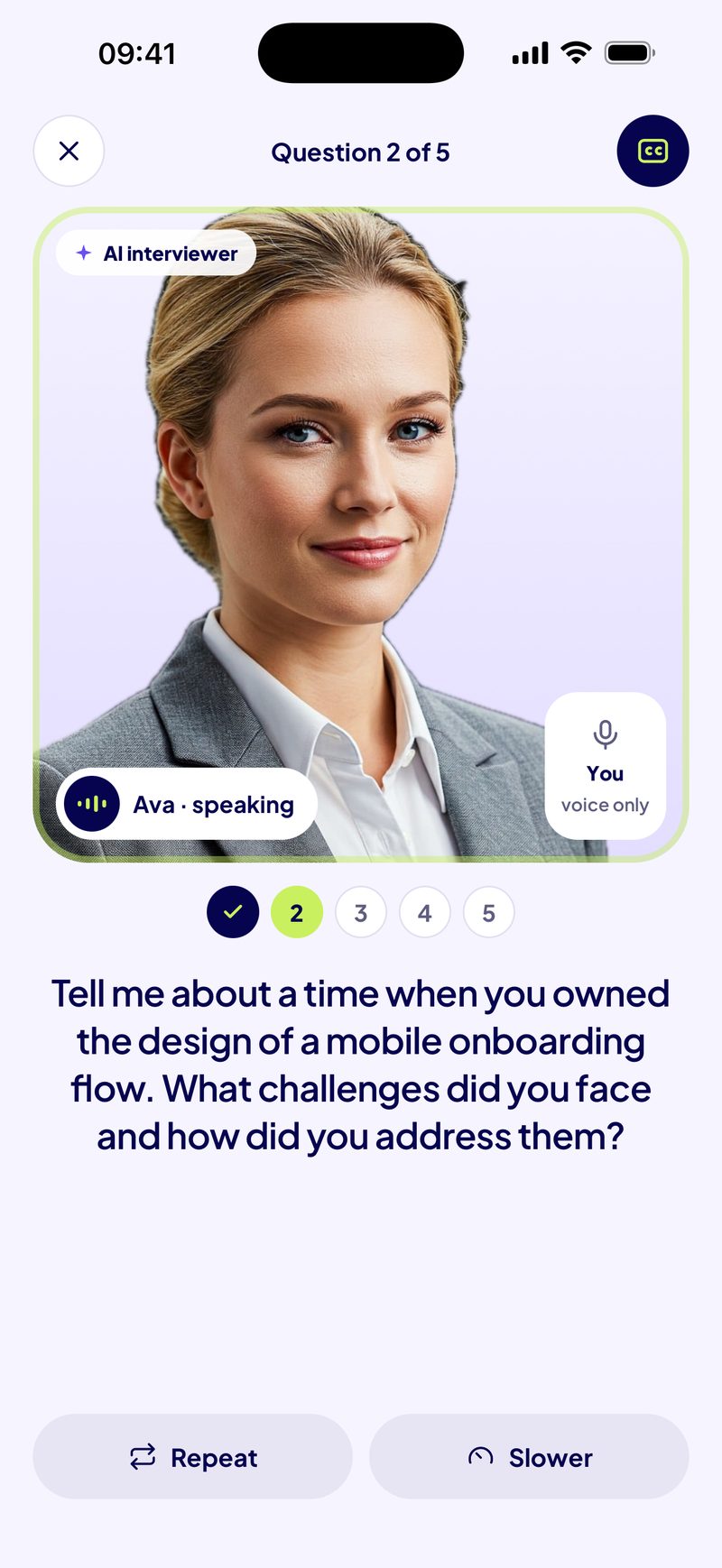
Readyo is an iPhone app for spoken mock interviews. You paste a job ad or type a role, choose the stage, and an AI interviewer asks the questions out loud. You answer by voice and get a report that scores relevance (20 %), structure (20 %), evidence and precision (30 %), clarity and expression (15 %), and composure and ownership (15 %), with an improved version of each answer built only from what you said. The interview and the app work in English, French, Spanish and Arabic. The interviewer is an AI and says so before you start. Readyo is for practice only: do not use it during a real interview. It is free to download, and interviews are paid.
Frequently asked questions
How many mock interviews should I do?
A few well-reviewed ones beat many rushed ones. Two or three full runs, redoing the weakest answers each time, is a reasonable start before an important interview.
Can a mock interview app replace a human coach?
No. An app gives repeatable practice and consistent feedback on structure and clarity. A person can also judge fit, nuance and industry specifics.
Is Readyo free?
Readyo is free to download, and interviews are paid in the app: a Single interview costs $2.99, an Interview Pass costs $7.99 for up to 10 interviews in 7 days, Pro costs $19.99 a month for up to 30 interviews a month, and Lifetime costs $79.99 once, with a fair-use limit of 30 interviews a month (US prices; the app shows your local price). Single, Pass and Lifetime are one-time payments that never renew, and Pro renews monthly until you cancel. A new account may be able to answer the first questions of one interview before choosing a plan; continuing that interview and its full report then require a purchase.
What are good practice interview questions?
Start with the ones that appear in almost every interview: tell me about yourself, why this role, a time you handled conflict, your greatest weakness, and what questions you have for them.
How long does it take to prepare for an interview?
A focused week is enough for most interviews: one day to read the job ad, one to research, a couple to prepare stories and answers, and the rest to practise out loud.